

Automating Your Finances: What to Delegate and What to Keep
Automation is one of the most powerful tools in modern business.
It can save time, reduce errors, and create consistency in how your money is managed.
But here’s where many business owners go wrong:
They either automate nothing… or automate everything.
Both approaches create problems.
The goal isn’t full automation—it’s smart automation.
Knowing what to delegate and what to keep under your control is the difference between efficiency and losing visibility.
Why Automation Matters
As your business grows, so does financial complexity:
- More transactions
- More accounts
- More decisions
Trying to manage everything manually leads to:
- Mistakes
- Delays
- Burnout
Automation solves this—but only when used intentionally.
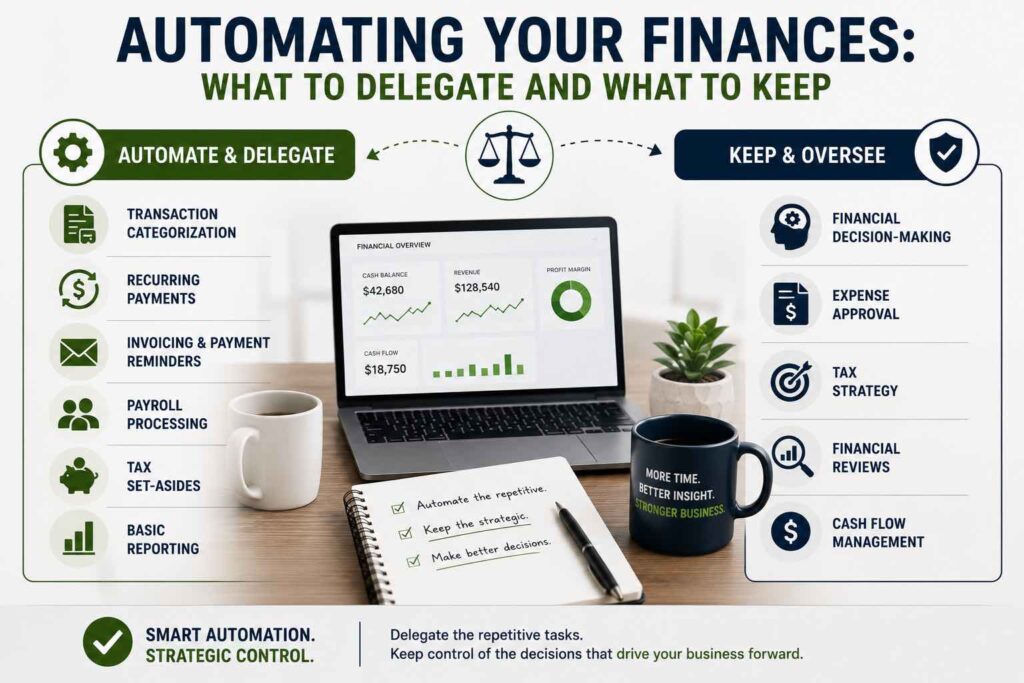
What You Should Automate
These are repetitive, rule-based tasks that don’t require constant judgment.
1. Transaction Categorization (With Oversight)
Modern accounting tools can automatically categorize many expenses.
This saves time and:
- Reduces manual entry
- Keeps records up to date
👉 Just make sure you review periodically for accuracy.
2. Recurring Payments
Automate:
- Rent
- Software subscriptions
- Loan payments
- Utilities
This ensures:
- Bills are paid on time
- You avoid late fees
- Cash flow timing becomes more predictable
3. Invoicing and Payment Reminders
Set up systems to:
- Send invoices automatically
- Trigger follow-up reminders
- Accept online payments
This improves:
- Collection speed
- Cash flow consistency
4. Payroll Processing
Payroll is structured and repeatable.
Automating it helps:
- Ensure accuracy
- Maintain compliance
- Save administrative time
5. Tax Set-Asides
Automatically transferring a percentage of revenue into a tax account can:
- Prevent surprises
- Build discipline
- Protect your cash flow
6. Basic Reporting
Dashboards and reports can be generated automatically.
This gives you:
- Real-time visibility
- Quick access to key metrics
What You Should NOT Fully Automate
These areas require judgment, strategy, and oversight.
1. Financial Decision-Making
Automation can provide data—but it shouldn’t make decisions.
You still need to decide:
- When to invest
- When to cut costs
- How to allocate resources
These require context and experience.
2. Expense Approval
Automatic payments are useful—but not all spending should be on autopilot.
For larger or discretionary expenses:
- Review before committing
- Evaluate ROI
This prevents unnecessary spending.
3. Tax Strategy
While some tax processes can be automated, strategy cannot.
You need to:
- Adjust based on performance
- Plan proactively
- Identify opportunities
This is where real savings happen.
4. Financial Reviews
Reports are helpful—but reviewing and interpreting them is critical.
You should regularly:
- Analyze trends
- Identify issues
- Make adjustments
Automation provides information—not insight.
5. Cash Flow Management
You can automate tracking—but not awareness.
You still need to:
- Monitor your cash position
- Anticipate upcoming needs
- Make decisions based on timing
The Right Balance
Think of automation as handling the execution, while you focus on the direction.
- Automation = efficiency
- You = strategy
When both are aligned, your financial system becomes:
- Faster
- More accurate
- More effective
Common Mistakes to Avoid
❌ Over-Automating Without Oversight
“Set it and forget it” can lead to errors going unnoticed.
❌ Under-Automating
Doing everything manually wastes time and increases risk.
❌ Ignoring the Data
Automation is useless if you don’t use the information it provides.
What Smart Automation Feels Like
When done right, you’ll notice:
- Less time spent on routine tasks
- Fewer errors and missed payments
- Better visibility into your finances
- More time to focus on growth
You’re not removed from your finances—you’re in control of them at a higher level.
Final Thought
Automation isn’t about replacing you.
It’s about freeing you to focus on what actually matters.
Delegate the repetitive.
Keep the strategic.
Because the goal isn’t just efficiency—it’s better decisions.
If you want help building a financial system that balances automation with control, working with a proactive advisor like STR CPA Firm can help you design processes that save time, reduce risk, and support smarter growth.